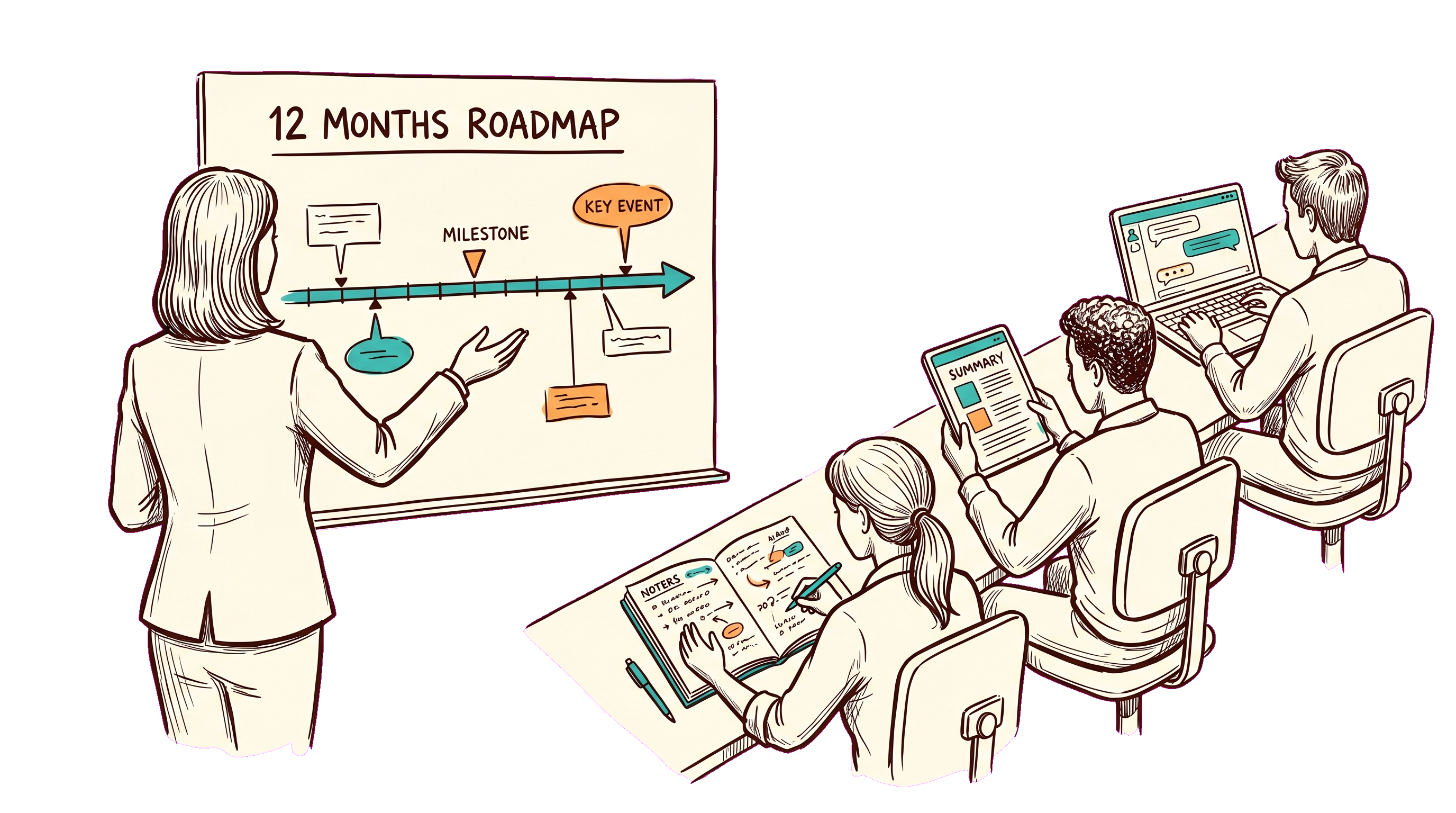
The most uncomfortable finding from Adecco Group's 2026 workforce survey isn't about AI. It's about who's listening. Adecco asked 2,000 C-suite executives across 13 countries when AI agents would be integrated into daily workflows. Forty-five percent said within a year. Then they asked the workers. Only thirty percent agreed. That fifteen-point gap is the story.
Look at the next pair of numbers and it becomes clear what kind of gap this is. Seventy percent of employees told Adecco they're personally ready to work with AI agents now. Only thirty-nine percent of leaders believe their workforce is ready. The mismatch isn't about capability. It's about visibility. The people on the ground know what they can do. The people at the top don't.
What the survey actually measured
Adecco surveyed C-suite leaders at companies with 1,000+ employees in 13 markets, and supplemented with workforce data from earlier waves. Five numbers ended up next to each other and refused to reconcile:
- 45% of leaders expect AI agents in workflows within twelve months
- 30% of employees expect the same
- 70% of employees consider themselves ready to work with those agents
- 39% of leaders believe their workforce is ready
- 36% of leaders say they have a clear talent strategy for the AI transition
The first two describe a strategy disagreement. The next two describe a perception failure. The last one is an organisational confession: nearly two-thirds of leaders are running an AI transformation without a plan for the people doing the work.
Why the gap is the real risk
Leaders read industry analyst reports. Employees use the actual tools. Both are right about what they see, and both are wrong about what the other knows. The leader looks at the McKinsey deck, builds a 12-month timeline, and starts cascading initiatives. The employee already used Claude or ChatGPT three times today to write a draft, summarise a doc, or explain a regex. The employee thinks: "We're already doing this, what's there to roll out?" The leader thinks: "They're not ready, we need a year of training."
Both responses make sense from inside their own information bubble. The problem is that neither side has a cheap way to find out what the other side actually knows. So the leader funds a training program nobody needs. The employee gets handed a vendor course on a tool they already use better than the trainer. Engagement drops. The trainer's logs show "low completion rate", and the leader takes that as proof that the workforce wasn't ready after all.
This pattern is older than AI. It's the same pattern as the 2010s "digital transformation" cycle, when half the workforce was already using Slack and Trello unofficially while leadership was still scoping a "collaboration platform RFP". The technology changes; the listening gap doesn't.
What to do instead
Treat AI readiness as a measurement problem, not a training one. Three moves close most of the gap inside a quarter.
Run a 5-question pulse. Once a month, ask the team:
- Which AI tools are you using for work right now?
- What tasks have you handed off to AI in the last 30 days?
- Where would AI help you most but you don't have it yet?
- What's blocking you from using AI more (skills, access, policy, time)?
- What's the biggest thing you've learned about AI at work this month?
You'll get a real-time inventory of de-facto adoption and a backlog of unmet needs. The leader's twelve-month roadmap and the employee's actual practice will start to overlap.
Centralise the playbook in a living KB. When someone figures out that Claude saves them four hours a week on customer summaries, that's company knowledge, not personal trick. A knowledge base owned by the team (not the L&D department) captures these patterns at the speed they emerge. Search it, contribute to it, link to it from 1-on-1s. Nothing else moves AI literacy faster than peers reading peers.
Tie role redesign to OKRs, not training hours. "Complete AI literacy module" is not a goal. "Reduce average customer-response time by 40% by Q3 by routing draft replies through AI" is a goal. The first measures attendance. The second measures the thing the AI transformation was supposed to deliver. If the OKR is met without the training module, the module was theatre. If the OKR fails despite the module, the module was wrong.
How DTPulse handles the listening side
DTPulse was built for exactly this kind of perception gap. Monthly pulse surveys with eNPS run in five minutes per employee and produce trend lines you can read at a glance: when 70% of the team says they're ready and the leader thinks 39%, you see it in week one, not in a delayed engagement survey six months later. The knowledge base is searchable and editable by the team, not gated behind L&D, so the "I figured out how to do X with AI" insights surface where work happens. One-on-ones run on a fixed cadence with a shared template, so the conversations about AI experiments don't get bumped by status updates. And goals/OKRs tie role redesign to outcomes the company actually cares about. See our pricing for what the toolkit costs at your team size.
We're not selling an AI agent. We're selling the instrument panel that tells you whether your AI bet is landing, and whether the people doing the work know things you don't.
The smaller question to start with
If the Adecco numbers sound like your company, run one experiment this month. Ask five people on your team, at five levels of seniority, to write down the three things they did with AI at work last week. Don't moderate, don't react, just collect. Compare what you get with what your AI strategy assumes the workforce is doing. The gap between the two lists is exactly the listening problem the Adecco survey found at scale. Closing it costs nothing. Ignoring it costs your AI strategy.