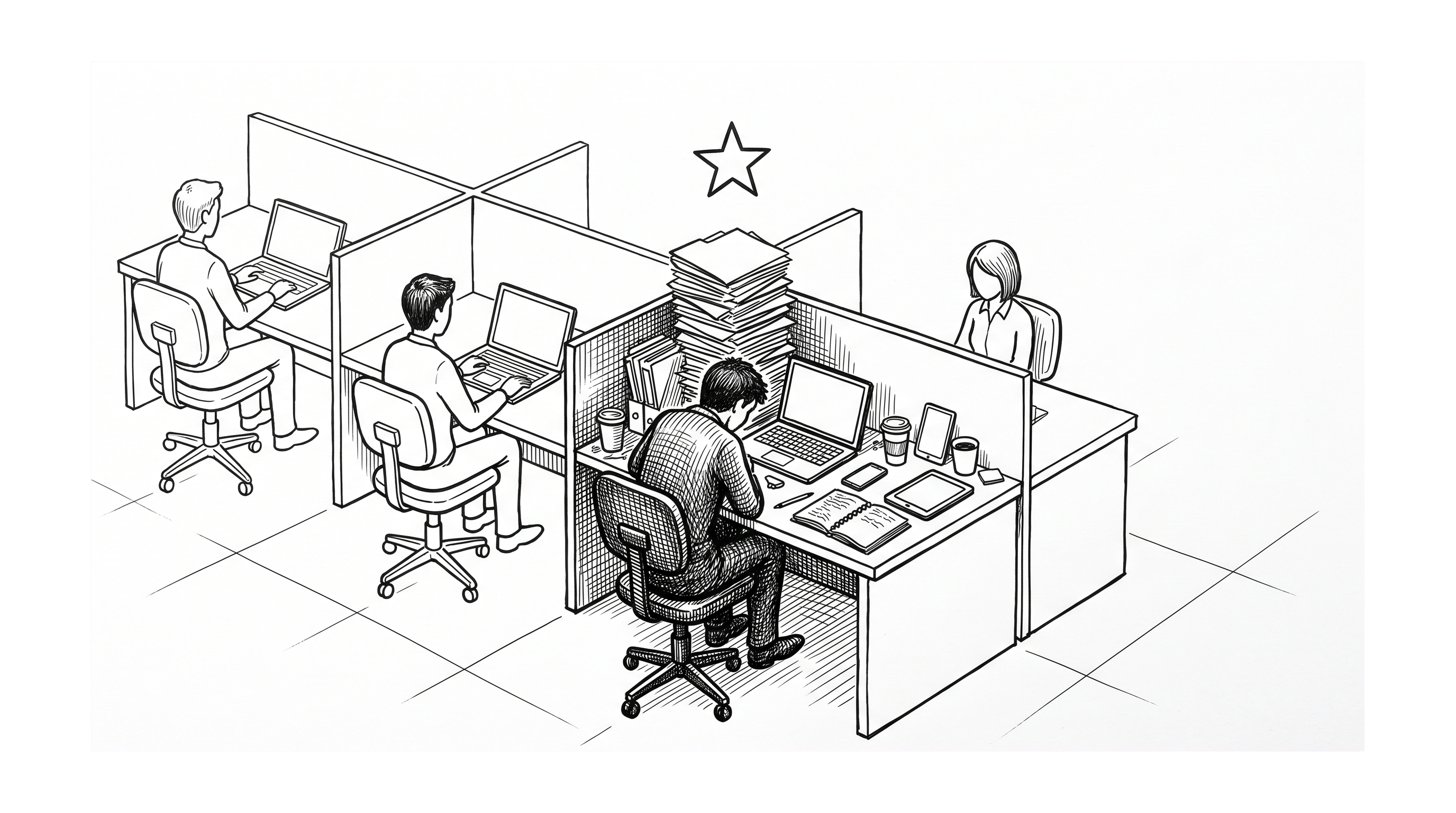
High-performer burnout is the most expensive HR problem of 2026, and HR teams are catching on. A new Wellhub survey reported by HR Brew on June 22 found that 88% of people leaders now name retaining top talent as their number-one priority. Eighty-five percent are leaning on wellness programs to do it. The reason is a chain of three uncomfortable numbers in the same dataset.
Fifty-three percent of top performers report active burnout right now. Ninety-one percent of organizations say losing one materially hurts the company. And the people running AI transformations inside most companies, the ones absorbing the extra workload that comes with new tooling and shifting priorities, are disproportionately drawn from that top-performer pool. Wellhub's CRO Carolee Gearhart put it cleanly: AI either amplifies burnout or amplifies performance, and the variable that decides which is whether HR is paying attention before the resignation letter lands.
Going silent on wellbeing while running an AI rollout, she said, is the costliest mistake a company can make this year. That maps almost one-to-one against what we see in customer data. The companies that have shipped meaningful AI tooling in the last twelve months are the same companies whose top engineers and PMs are at the highest risk of leaving, because those exact people did the integration work, absorbed the cultural change, and now look around to find that their workload didn't actually compress, it just shifted shape.
Why averages hide the high-performer signal
The default engagement-survey setup at most mid-size companies reports a single org-wide eNPS, then a breakdown by department. That's where the analysis stops. The number that matters in the Wellhub data is missing from almost every dashboard we walk into: the eNPS slice for top performers specifically.
When you average a top performer's burnout score against the rest of the team, the signal gets diluted into noise. A team of ten where one star engineer is at a 2 and nine merely-fine engineers are at a 4 will report a team average of 3.8. That looks healthy. The star engineer is two weeks from quitting. The team will discover this the day she gives notice.
The fix is operational, not philosophical. Whatever signal you collect from engagement surveys, slice it by grade tier and by the people you've internally flagged as top performers in the last two performance cycles. Track that slice separately. If it diverges from the company-wide number by more than five points for two consecutive months, that's a board-level alert, not a Q3 conversation.
The five questions worth asking your top tier specifically
A general engagement survey is built to surface average problems. To surface high-performer-specific problems you need questions that target the failure modes top performers actually experience. They don't fail at "I don't know what's expected of me." They fail at five different things.
Workload boundary. Top performers don't say no. The question to ask is "in the last two weeks, how often did you work outside your normal hours because the work wouldn't get done otherwise?" Numeric answer. If the team average is two evenings a week and your top performers are at five, you have a boundary problem that has nothing to do with their motivation.
Strategic clarity at the edge of their job. The questions to ask top performers aren't about whether they understand their KRs. They do. The question is whether they understand how their work connects to the next-quarter bet the company is making. When that connection breaks, they start looking. "Do you feel you understand what your work contributes to over the next 6 months?" on a 5-point scale.
Growth runway. A top performer at a flat plateau for nine months is a top performer halfway out the door. Ask "have you grown in a meaningful way in the last 6 months?" with a free-text follow-up. Quantitative score plus the qualitative reason. The reasons cluster, and they cluster differently from the average employee.
Manager bandwidth. Top performers are usually self-managing. That makes their managers think they need less attention, which is exactly backwards. The right question is "in the last month, did your manager have time for a real conversation about your work, not just status?" Yes or no. When the answer drops to "no" for two months in a row, the manager has reallocated their attention away from the people most likely to leave.
Recognition latency. The most common silent reason top performers leave isn't compensation. It's that nobody noticed their last big win. "When did you last receive recognition for work you're proud of?" with options: this week, this month, this quarter, longer. If a top performer answers "longer" and your award/recognition system doesn't ping the manager, you're losing the war on a Tuesday morning.
What HR should connect to those signals
Five questions surface signal. Acting on signal is a different muscle. The companies that retain top performers through transition periods run three things in parallel, not as separate initiatives.
A monthly award nomination cycle that the survey data feeds into. When a top performer shows up in the bottom decile of recognition latency, the system automatically nudges their manager to write a recognition or nominate them for an award. The cost of the nudge is zero. The cost of skipping it is one resignation in 90 days.
A lightweight quarterly 360 specifically focused on high-leverage employees, not the whole company. Not for ranking, not for compensation. For the employee. Three peers, manager, two reports. Twenty minutes per respondent. The output: a one-page read on how the person is currently seen, with one growth conversation scheduled within two weeks. This is what closes the "growth runway" gap before it metastasizes.
A grade and competency framework that gives those people somewhere to go. Top performers stall when the next level on their grade ladder is undefined or feels unreachable. If "Senior Engineer" has no clear path to "Staff" written down anywhere, the easiest answer to "what's next" becomes the LinkedIn message from a recruiter.
How this gets handled in DTPulse
The three instruments above already exist in most modern HR portals; the difference is whether they're wired together. In DTPulse, the pulse survey, the award nominations, and the 360-review and competency matrix live in the same surface. A pulse trend on a top-performer cohort feeds into the manager's dashboard with the same identifier the recognition module uses to suggest an award. The 360 cycle for that cohort can be triggered as a separate workflow without launching it for the whole company. The competency matrix tells the manager exactly where the person is in their grade ladder when they sit down for the growth conversation.
The reason this matters is not that any single piece is novel. The pieces exist in standalone tools. The reason it matters is that when top performers leave, the post-mortem almost always finds that a signal showed up in one tool and never made it to the other. Pulse said burnout was rising for a specific cohort. Recognition system didn't know. 360 hadn't run for them in six months. Three months later the offer letter landed and HR was caught flat-footed. Consolidating those three loops in the same product compresses the catch-window from quarters to weeks.
What to ship this week
If you've never asked your top tier these specific questions, ship a five-question pulse survey to the people in your top 20% performance cohort this week. Anonymous within the cohort, attached to nothing in their HR record. Compare the answers to your most recent company-wide pulse data. The delta is the actual signal.
If you don't have a top-performer cohort defined, define it. Your last two performance review cycles plus your last quarter's promotion list plus the names every senior leader can rattle off as critical. It won't be perfectly accurate. It doesn't need to be. It needs to exist as a list you can target with a survey.
The Wellhub data names a problem that isn't going to slow down through 2026 and 2027. AI transformations will keep loading work onto the same shoulders that did the previous wave. The companies that come out of this with their top performers still on payroll will not be the ones with the biggest wellness budgets. They will be the ones with HR teams that ran their measurement loop on the top cohort specifically, weekly enough to catch the slide before it became a goodbye.