Office utilization just did something nobody predicted five years ago: it beat the pre-pandemic baseline. CBRE's new global workplace report, covered by HR Dive this week, puts peak office use at 80% on the busiest days, above the 65 to 75% that was normal before 2020. Average use jumped from 38% in 2024 to 53% in 2025, the largest annual increase since 2021.
For years the story was the empty office. Companies wrote off floors, subleased space, and argued about whether anyone would ever come back. Now the pendulum has swung hard enough that the new problem is the opposite one: on peak days there are more people than seats.
The numbers behind the comeback
The headline figure is striking, but the details matter more for anyone who runs a workplace.
Enforcement is real now. The share of organizations actively enforcing in-office policies doubled to 37% in 2025, and 69% of workplaces measure compliance with those policies, up from 45% a year earlier. Attendance stopped being a suggestion and became a tracked metric.
Space itself has been rebuilt while people were away. In the Americas, shared and collaborative spaces grew 35% between 2021 and 2025, individual task spaces shrank by roughly the same amount, and amenity and social spaces grew 120%. The office people are returning to has fewer desks per head than the one they left.
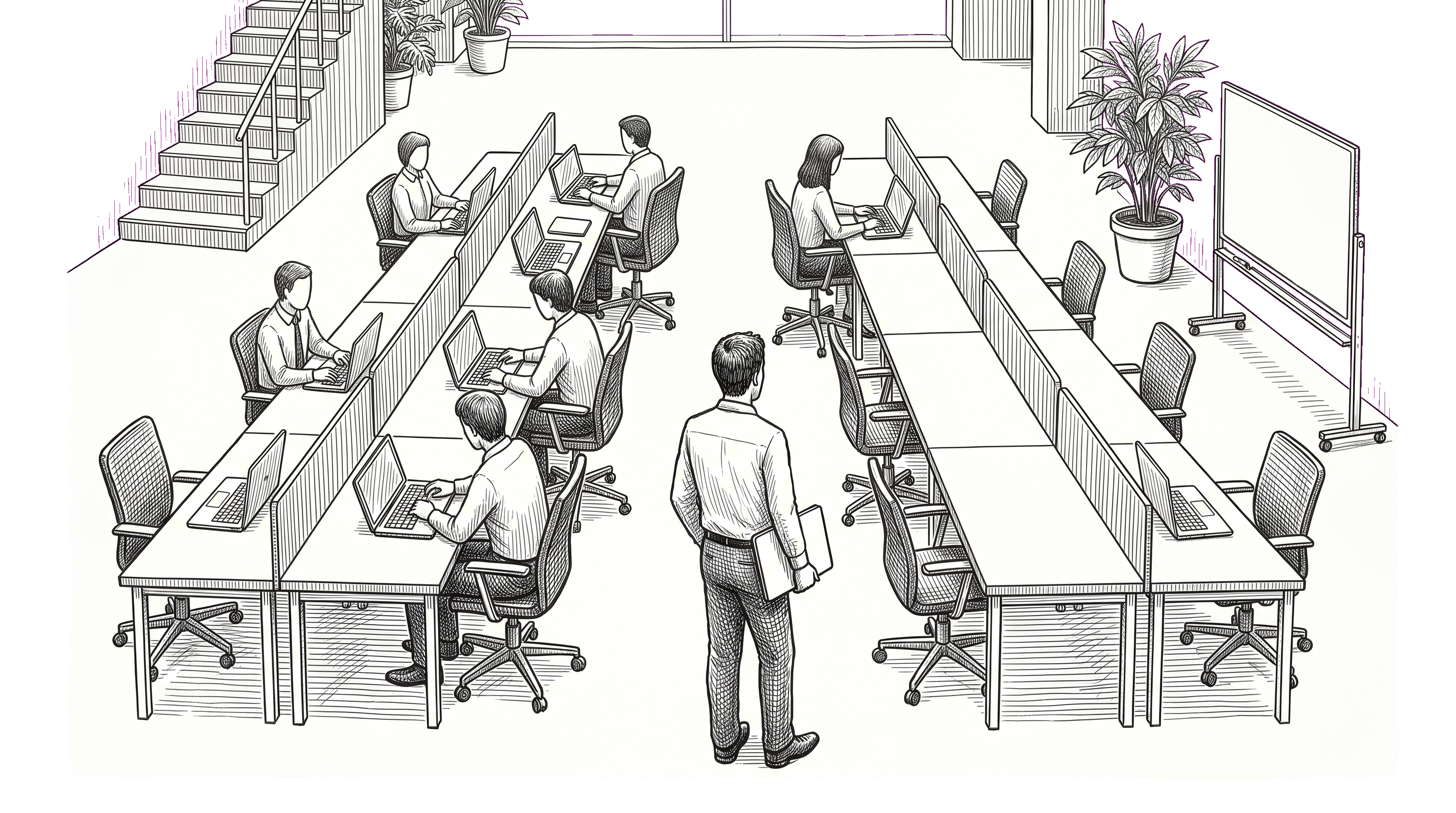
Which leads to the most consequential number in the report: desk sharing is now the default. Most organizations run between 1.01 and 1.49 employees per seat, and global occupancy rates reach 111%, meaning more people are assigned to an office than it has chairs. The strict 1:1 mapping of one employee to one permanent desk, the model that defined office life for a century, is effectively gone. And 83% of organizations now factor job function into how sharing ratios are set: engineers, salespeople, and support teams get different arrangements because their weeks look different.
Sharing ratios are a bet, and someone has to manage it
A ratio of 1.2 employees per seat is a bet that not everyone shows up at once. The CBRE data shows the bet mostly pays off, since even 80% peak utilization leaves headroom at a 1.2 ratio. But averages hide the bad days. One all-hands, one quarterly planning week, one rainy Tuesday after a holiday, and the bet fails: people circle the floor with a laptop looking for a place to sit, and the first thing they conclude is that the company demanded their presence without preparing for it.
That failure mode is not a real-estate problem. It is a trust problem, and it lands on HR. Return-to-office mandates already spend political capital. A mandate that delivers an employee into an office with no desk spends it twice.
The organizations getting this right treat seat capacity as an operational system rather than a furniture layout. Three practices show up consistently.
First, the map is public. Everyone can see the floor plan, which seats exist, which are bookable, which belong to teams, and who is sitting where today. Hunting for a colleague in a shared-seating office without a live map wastes exactly the collaboration time the office was supposed to enable.
Second, presence data and seat data live together. Knowing that 140 people are assigned to a floor with 100 desks tells you nothing about Thursday. Knowing that 32 of them are on vacation, remote, or traveling tells you everything. Absence tracking and seat planning are usually two disconnected systems owned by two different departments, and the disconnect is where overbooking surprises come from.
Third, ratios are set per team, not per building, which matches what the 83% in CBRE's data are already doing. A support team that answers phones five days a week cannot share desks at 1.4. A sales team on the road most of the week can share at 2:1 without anyone noticing.
Measurement is here, so make it symmetrical
The most uncomfortable stat in the report is the 69% of workplaces measuring attendance compliance. Employees know they are being counted, and one-way surveillance breeds quiet resentment: the company sees whether I badge in, but I cannot see whether coming in is worth it.
The fix is symmetry. If the company measures presence, employees should get the benefits of that data: seeing which days their team is actually in, finding a desk near the people they need, checking whether the office will be packed before committing to a commute. CBRE's own report makes this point in gentler language, noting that "culture is cultivated, not assumed," and that space allocation tells employees what the company expects them to do when they show up. An office rebuilt for collaboration but managed like an attendance sheet sends two contradicting messages.
This is the layer where an employee portal earns its keep. In DTPulse, the office map with seat markers, the absence calendar, and the org chart sit in one system: an employee checks who from their team is in tomorrow and picks a desk next to them in the same view where they would request vacation. If you are moving from assigned seats to shared ones, we wrote a separate practical guide on rolling out hot-desking without a mutiny.
What to do this quarter
If your organization is anywhere near the numbers in this report, three moves are worth making before the autumn peak season.
Audit your real ratio. Count assigned people against usable seats per floor and per team, not per building. Most companies discover they are already above 1:1 in some teams and have never told those teams.
Put the floor plan where employees already are. A seating chart in a facilities PDF does not help the person arriving at 9:15. A live map in the portal they open every day does.
Connect absence data to capacity planning. Your absence calendar already knows next Thursday's real headcount. If your seat planning cannot see it, you are forecasting with your eyes closed.
The empty-office era ended faster than anyone scheduled it to. The companies that come out of this transition well will not be the ones with the most square meters, but the ones where showing up never feels like a logistics gamble.