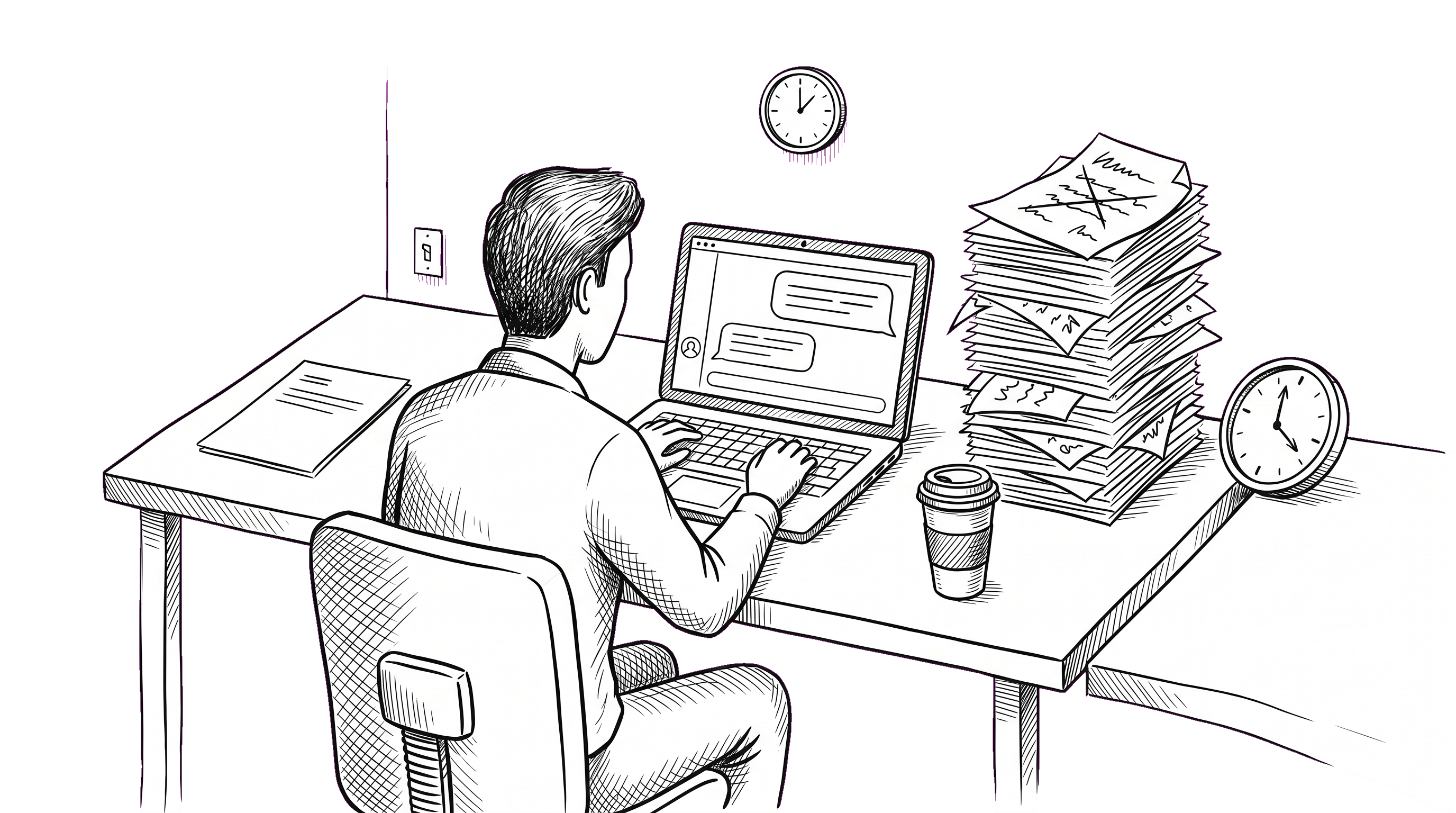
A new number landed this week that should reshape how HR teams talk about AI productivity. Glean's inaugural Work AI Index, surveying 6,000 digital workers and reported by HR Dive on June 11, found that for every hour an employee gets useful output from an AI tool, they spend roughly another hour managing it. Verifying. Re-prompting. Fact-checking. Editing the slightly wrong thing into the actually right thing. The headline savings of about 11 hours per week from automation are largely eaten by 6 to 7 hours of cleanup.
The kicker is the perception gap. Three quarters of knowledge workers in the survey say AI makes them personally more productive. Only 13% say it has meaningfully moved their company's performance. That is a 60-point gap between how people feel about AI at their desk and what HR and finance can actually see in the KPIs. It is the most important HR-tech data point of the quarter, and most people will read past it.
Why the gap is real, not just measurement noise
The standard reflex when you see a perception-vs-reality gap that wide is to assume one of the two numbers is wrong. Either employees are overestimating their own gains, or the company metrics are too lagged to catch them yet. Both are partially true. Neither explains the whole gap.
What actually explains it is that the unit of measurement is different. When an employee reports "AI made me more productive," they are comparing the moment of doing the work today against the moment of doing the same work a year ago. The act of writing a first draft, summarizing a meeting, pulling a quick chart together — these are observably faster. That part of the perception is correct.
What the employee does not see is the second hour. The slack message asking a colleague to re-check the AI-generated number. The 20 minutes spent reconciling two outputs from two different tools that disagreed. The Tuesday afternoon when the AI confidently produced a customer-facing email with the wrong product name and someone had to chase the rollback. These costs are invisible because they don't feel like AI cost. They feel like normal work. The first hour gets credited to AI. The second hour gets credited to operations.
So the company sees the aggregate. Eleven hours saved minus six and a half hours of cleanup is roughly four and a half hours of net gain per knowledge worker per week. That is a real number. But four and a half is not eleven, and the difference is exactly where the company performance numbers are flat-lining while employee satisfaction with AI tools is climbing.
What HR can actually measure here
This is a measurement problem, not an enthusiasm problem. Pulling AI tools back wins nothing. Telling everyone the tools are good wins nothing either. What wins is closing the loop between what employees feel about their AI usage and what shows up downstream in goals, reviews, and output quality.
Three instruments in a typical HR stack already handle this if you point them at it.
Pulse surveys can ask the second-hour question. Most engagement pulses today ask whether employees are using AI tools and whether they find them helpful. The "helpful" question is the one returning the 75% number. It is not useful on its own. A better pair of questions: "in the last week, roughly how many hours did you save using AI tools?" and right after it, "in the last week, roughly how many hours did you spend verifying, fixing, or redoing AI-generated work?" Both numbers self-reported, both noisy, but the ratio between them across teams is exactly the signal you want. If team A reports 6 hours saved and 1 hour cleanup, and team B reports 8 hours saved and 7 hours cleanup, those two teams are using AI very differently and the conversation with team B's manager writes itself.
Goal periods catch the company-side number. The Glean survey's 13% figure — the share of workers who say AI is moving company performance — exists because individual self-perception of speed has been disconnected from team-level deliverables for the entire AI wave. OKRs and goal periods are the cleanest place to reconnect them. If a quarterly goal was "ship the redesigned onboarding flow by end of Q2" and the team feels 75% more productive because of AI, the goal should ship earlier or with more scope, not in the same week with the same scope. When that doesn't happen quarter after quarter, the gap stops being abstract.
The competency matrix lets you separate the careful operators from the over-trusters. Right now most companies treat "uses AI tools" as a single competency, scored binary. The Glean data suggests the meaningful split is more like three buckets: people who use AI as a draft generator and verify everything before it leaves their hands; people who use it as a reference and write the final output themselves; people who paste AI output into customer-facing channels without reading it. These are completely different operating modes with completely different second-hour costs. A competency framework that distinguishes them — "uses AI tools effectively, verifies output, flags hallucinations" rather than "uses AI" — moves the review conversation from "do you use it" to "how well do you use it."
What the next year of the AI productivity story looks like
The Glean number will not be a one-time data point. Expect three or four more reports through the back half of 2026 from McKinsey, Gartner, and the major HRIS vendors hitting similar findings. The framing will shift from "AI is making everyone more productive" to "AI is making everyone feel more productive while company-level metrics lag." Press cycles will run. Investor questions on Q3 earnings calls will get sharper.
The companies that handle this well will not be the ones that buy more AI tools or fewer. They will be the ones whose HR teams already had a measurement loop in place that could surface the second-hour cost at the team level, in real time, before it became a board-level question. Which is to say, the companies that were already running disciplined pulse surveys, structured goal periods, and competency frameworks granular enough to distinguish "uses AI" from "uses AI well."
This is the kind of moment a unified employee portal is built for. Pulse surveys to surface the team-level ratio of saved-to-cleanup hours. Goal periods to track whether the saved hours actually compress the calendar. Competency matrices to grade how carefully people are using the tools. One platform, one login, one signal across the three instruments. The cost of doing it that way is small. The cost of waiting another six months and discovering the gap from a board slide is large.
The one question to ask in your next staff meeting
If you're an HR leader who has never asked this in your last three pulse surveys, ask it in the next one. "For every hour AI saved you this week, how many hours did you spend cleaning up after it?" One question, free-text or numeric, no judgment. The answers will tell you more about your company's actual AI maturity than the last four vendor reports combined. And if the average answer is anywhere close to one-to-one, you now know exactly where the gap between employee enthusiasm and company KPIs is hiding.