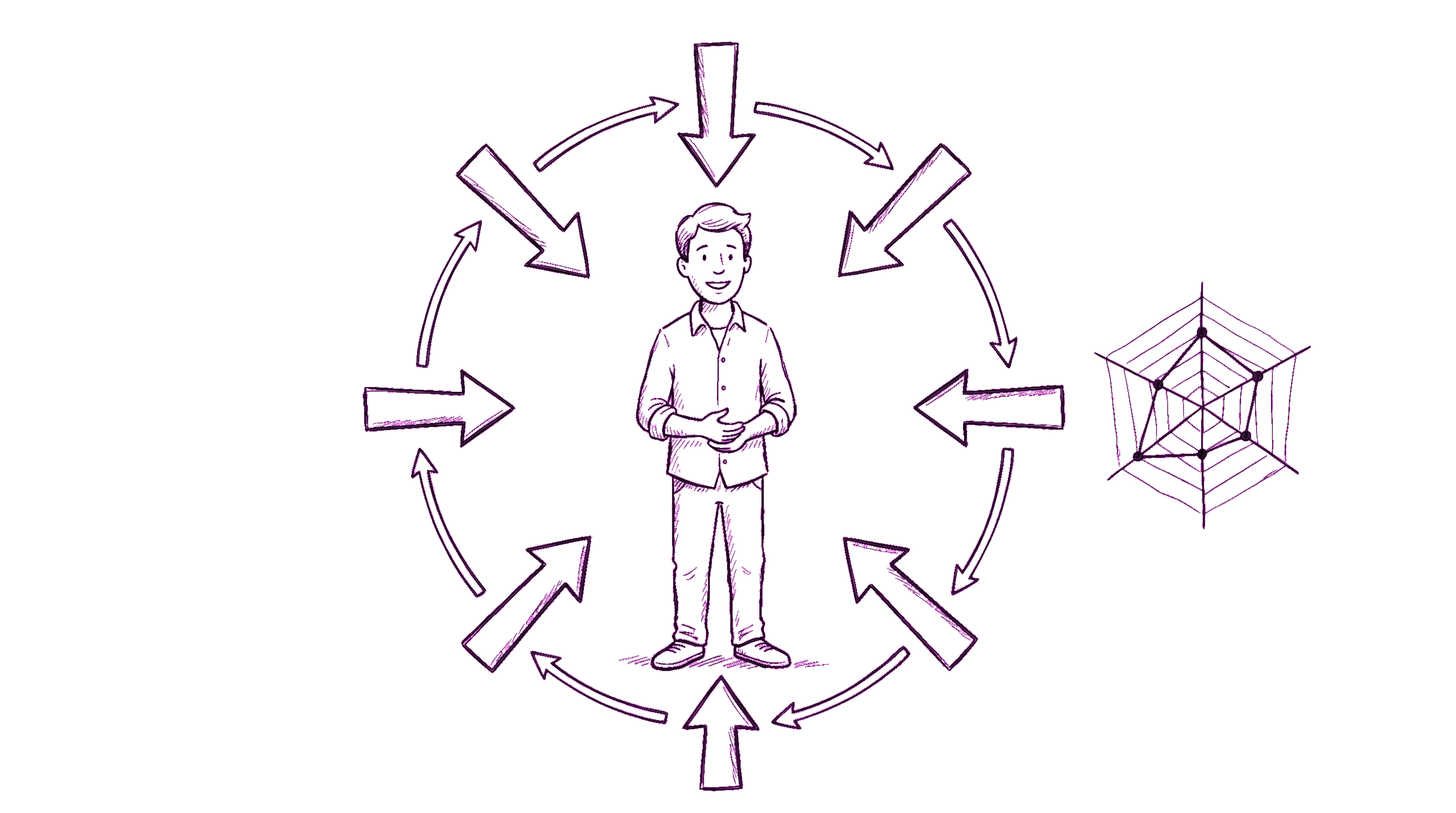
In every "we should do 360 reviews" conversation, the cycle is predictable:
- HR proposes a 360 review.
- Three managers push back: "We tried it three years ago, it was a disaster, took six weeks, nobody was honest."
- HR insists.
- The process happens. It takes six weeks. Nobody is honest.
- The review report is filed, nobody reads it, the conclusion is "this process needs refinement."
- Two years later: goto 1.
The reason 360s fail this consistently isn't that the concept is bad — it's that the default design choices stack against honesty and against signal. Here are the five choices that change that.
1. Choose a competency framework BEFORE you choose the tool
The most common 360 failure: a tool that ships with 47 default competencies, an admin who doesn't customize them, and reviewers staring at "Strategic Vision" trying to remember if the engineer they're reviewing displayed strategic vision in the last quarter.
Better order:
- Pick 4–8 competencies max. Across all roles, the same set. Examples: technical depth, communication, ownership, collaboration, customer focus, leadership (only for those who manage). Resist the urge to add a 9th.
- Write a 1-sentence definition for each. "Communication: writes and presents ideas clearly so others can act on them without follow-up." Not vague.
- Define the scoring scale anchors. What does a "3" mean vs a "4"? Without anchors, scores cluster at "4 — they're a solid performer" universally.
- Then configure the tool.
A serious portal lets you customize the competency set per role family (engineering, sales, support) but with significant overlap so cross-role 360s are still comparable.
2. Pick reviewers from the relationship graph, not by self-nomination
"Pick 5 people to review you" sounds empowering. In practice it produces a curated group of friendly colleagues who give 4s and 5s.
Better: have the system propose a reviewer pool from the actual work relationships, then let the reviewee veto with reason. Pool sources:
- The reviewee's manager (always).
- 2–3 direct reports (if they have any).
- 2–4 cross-functional peers based on Slack DMs / calendar overlap / Jira interactions. (If your portal doesn't integrate this, derive from "people who recently worked on the same projects".)
- 1–2 customers or external collaborators where appropriate.
Veto with reason is important — sometimes the obvious peer is in active conflict and that's a real reason to skip them. But the default should be "the people you actually work with", not "the people you want to review you."
3. Mix free-text + structured scores; ditch one-or-the-other
The tooling debate splits into two camps:
Pure quantitative: 1–5 scores on 8 competencies. Output: a radar chart. Easy to aggregate, but reviewees push back on the chart with "this doesn't tell me what to actually change."
Pure qualitative: open-ended prompts. "What should this person stop doing? Start doing? Continue doing?" Rich answers, but you can't trend across cycles or compare.
The both-and approach works better:
- 1–5 scores on the small competency set (for trending).
- For each competency, an optional "evidence" text field: "If you scored them above or below average, give one example."
- Three free-text prompts: "What should they do MORE of? Less of? Differently?"
The "evidence" field is the unlock. It forces reviewers to ground numerical scores in observation, which reduces score inflation and gives the reviewee something actionable.
4. Anonymity needs a clear contract
Anonymity is the single thing reviewees ask about most. The wrong answers are "fully anonymous" (which is a lie if you can guess the reviewer from writing style) or "named" (which suppresses honest feedback).
The contract we recommend:
- Scores are anonymous in aggregate: only "average across 5 reviewers", never individual scores. Anyone can see "you scored a 3.2 on communication"; nobody can see "Igor gave you a 2."
- Free-text answers are forwarded with reviewer name visible to the reviewee — but only if the reviewer opts in. The form has a "include my name with this comment" toggle per response.
- Manager sees all of the above plus reviewer identities (so they can spot patterns and biases).
This is the design that produces honest scores AND useful text. Reviewers who want to be quoted by name can do so; reviewers with sensitive feedback can stay anonymous in the text too. Reviewees can't game it because nobody can tie a specific score to a specific person.
5. Cap the cycle at 3 weeks
Long cycles fail. 6-week cycles definitely fail. 8-week cycles fail with extra cynicism.
A working cycle:
- Week 1: HR configures the cycle, picks reviewees, system proposes reviewer pools.
- Week 2: Reviewers fill out forms. 30 minutes per review max. Reminder day 3, reminder day 6, manager-escalation day 9.
- Week 3: Manager reviews aggregated results with each reviewee in a 30-minute 1:1. Output: a 3-bullet development plan with deadlines.
Anything longer is a process that meanders. The reason teams stretch to 6 weeks is "to allow people enough time", but in practice extra time produces procrastination, not better reviews.
What you skip in cycle 1
Resist the temptation to do everything in the first cycle. Specifically skip:
- Calibration sessions between managers (force-rating to a curve). Wait for cycle 2 — you need a baseline first.
- Compensation linkage. First cycle is developmental only. Saying "this affects your raise" in cycle 1 guarantees inflated scores.
- Self-review. Adds friction, rarely adds signal. Add in cycle 3 if you genuinely want it.
- Goals integration. "Did they meet their goals" is a different conversation; conflating it with "are they good at the job" muddles both.
Cycle 1 is about building trust in the process and proving it produces actionable output. The accuracy + sophistication compound from cycle 2 onward.
How DTPulse approaches this
For the curious: in our 360-review module, the competency set is per-tenant configurable (with a sensible default library), reviewer pool is admin-set with self-veto, scores are 1–5 with required text evidence on outlier scores, free-text answers have an opt-in "name visible to reviewee" toggle, and the cycle length is admin-settable (we recommend 3 weeks and warn in the UI when admins pick longer).
This is deliberately opinionated software. We've seen too many tools that "support" every workflow and let admins build dysfunctional ones. The default path here is the path we've seen work.