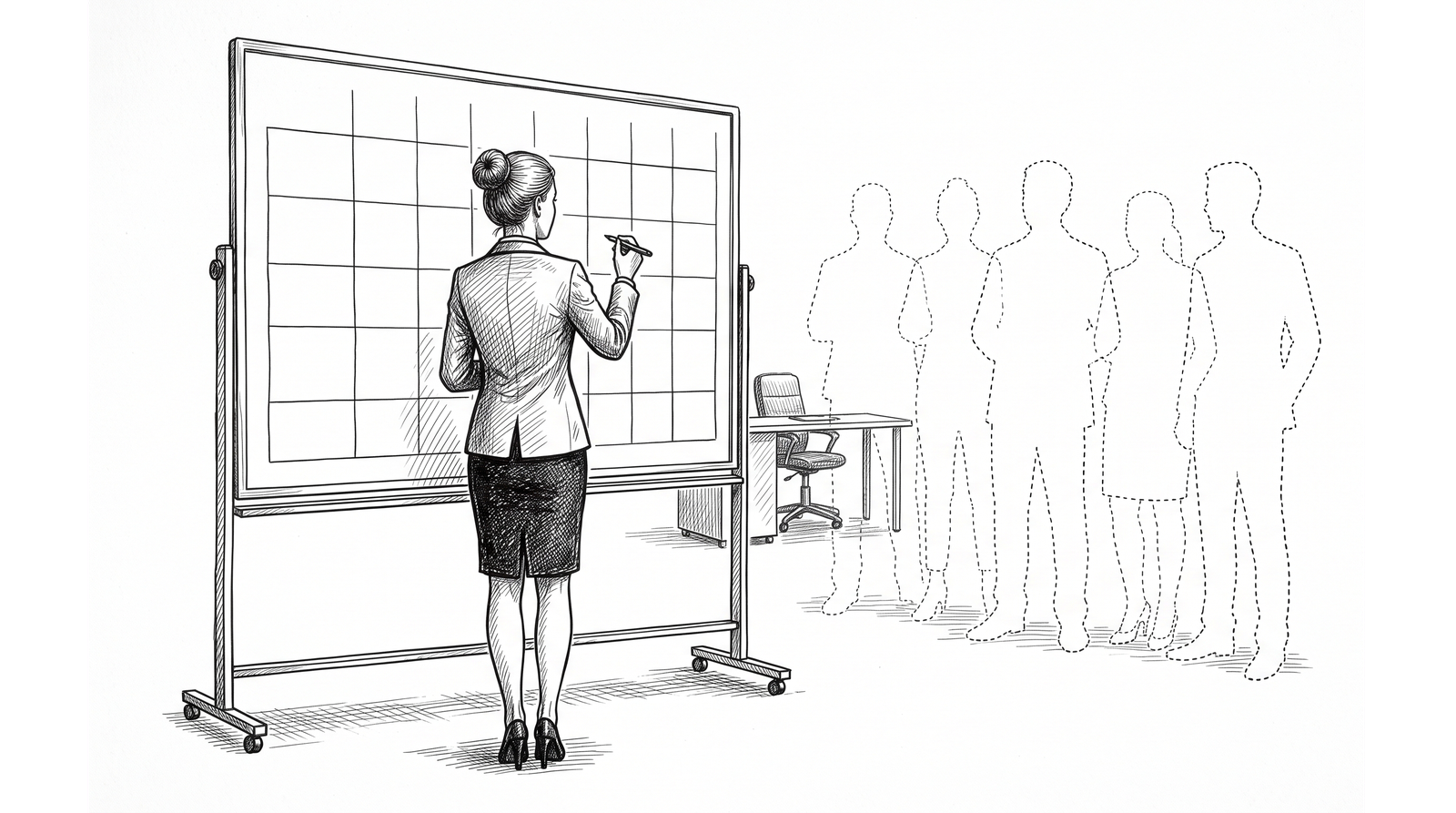
The skills visibility gap is the distance between knowing which skills your company needs and knowing whether your people actually have them. A new Harris Poll for University of Phoenix puts a number on it: 64% of HR leaders are very confident they know the skills employees need, but only 43% are very confident employees have them. That 21-point gap is where most workforce planning quietly goes wrong.
What the survey found
HR Dive reported the findings on September 30. The survey covered 755 US HR and L&D managers and above, fielded in July 2026. The headline number is the confidence gap, but the more useful detail is how HR teams try to see skills today.
Two methods dominate, each used by 51% of respondents: what managers know about their people, and performance reviews. In other words, the main skills database in most companies is a manager's memory, refreshed once or twice a year when a review form comes around.
And here is the catch. Only 49% of HR leaders say their managers are very prepared to identify, assess and discuss skill gaps. So the primary source of skills data is a group that, by HR's own account, is not well equipped to produce it. Looking ahead doesn't help much either: just 46% are very confident they can predict the skills needed two to three years out, and 27% name keeping pace with technology, including AI, as their biggest source of uncertainty.
Put those numbers side by side and the pattern is clear. HR is fairly sure about demand, the skills the business needs, and much less sure about supply, the skills people actually have. Demand is easy to write down: you can list it in a strategy deck. Supply lives in hundreds of individual heads and changes every month as people learn, move teams or leave. That's why the gap appears in almost every company that grows past the point where one leader knows everyone personally, which for most teams happens somewhere around 50 to 100 people.
Why manager memory is a weak skills map
Managers know a lot about their people. They know who handles a difficult client well, who writes clean code, who goes quiet in meetings. The problem isn't the quality of that knowledge. It's that it stays in one head.
It doesn't add up across the company. If you want to know how many people in a 300-person organization can run a project end to end, you can't ask 30 managers and sum their impressions, because each of them means something slightly different by "can run a project."
It leaves with the manager. When a team lead changes jobs, a large part of what the company knew about that team's skills goes with them.
It's lopsided. Managers remember recent and visible work. Skills used quietly or a year ago fade. People who are good at showing their work look more skilled than people who are good at the work.
It's also invisible to the employee. Most people have no idea what their manager thinks they're good at. They find out at review time, if at all, which is too late to do anything about it and a reliable way to start an argument.
Annual performance reviews don't fix this. They capture one person's judgment once a year, usually mixed up with pay decisions, which makes everyone careful about what gets written down.
Make skills visible, not just assessed
The survey has one more finding worth noting: 59% of HR leaders focus development on durable skills like communication, collaboration and problem-solving, against 37% for technical skills. As Nathan Jones of University of Phoenix put it, "Increasingly, people need both." Durable skills are exactly the ones a manager's memory captures worst, because they show up in how people work with others, not in a single deliverable.
So the fix isn't a better review form. It's a shared, written-down picture of skills that several people contribute to and that changes during the year.
Start with a competency matrix per role. For each level, list what someone at that level is expected to do, in concrete terms. "Leads a cross-team project from kickoff to release" can be checked. "Strong leadership" can't.
Let employees mark what they've mastered and have managers confirm it separately. Two independent signals beat one. Where they disagree is exactly where a useful conversation should happen.
Bring in more than one viewpoint on durable skills. 360 reviews that people don't dread are the most reliable way to see collaboration and communication, because peers see them daily and managers often don't.
Keep it alive in regular one-on-ones. If skills only come up once a year, the map goes stale within months. A short check-in on progress toward the next level keeps it current and gives managers the practice the survey says they lack.
Mistakes that make a skills map useless
The first is making it too detailed. A matrix with 80 competencies per level looks thorough and gets filled in once. Nobody updates it, and within a quarter it describes a team that no longer exists. Ten to fifteen requirements per level, written so that a manager can check them in a conversation, will stay in use.
The second is tying it straight to pay. The moment a checkbox decides a raise, employees mark everything and managers mark nothing, and the matrix stops describing skills at all. Keep it as a development tool first. Pay decisions can look at it, but it shouldn't be a calculator.
The third is building it without the people who'll use it. A matrix written by HR alone tends to describe the job as HR imagines it. Write each role's levels with two or three people who actually do the work and one manager, then let the rest of the team comment. It takes longer the first time and saves months of arguing later.
The fourth is treating it as a one-off project. Roles change, especially now, when AI tools reshape what a junior analyst or a support specialist actually does. If 27% of HR leaders say keeping pace with technology is their biggest uncertainty, the skills map has to be something you revise every few months, not a document you publish and forget.
How DTPulse handles it
DTPulse has grade tables with a competency matrix per role and level. Employees check off the requirements they've met, managers confirm with their own independent check, and HR sees the progress across the org tree as two percentages per person. 360 reviews add peer views on the softer skills, and 1-1 meetings keep the agenda and follow-ups in one place so development doesn't stall between reviews. None of it replaces a manager's judgment. It writes that judgment down next to the employee's own view and peers' input, so HR can plan from it.
The takeaway
Ask one question this week: if a manager left tomorrow, what would you still know about their team's skills? If the honest answer is "not much," pick one role, write down what each level requires, and have both employees and managers mark it. That single matrix will tell you more about your skills gap than another confidence survey.