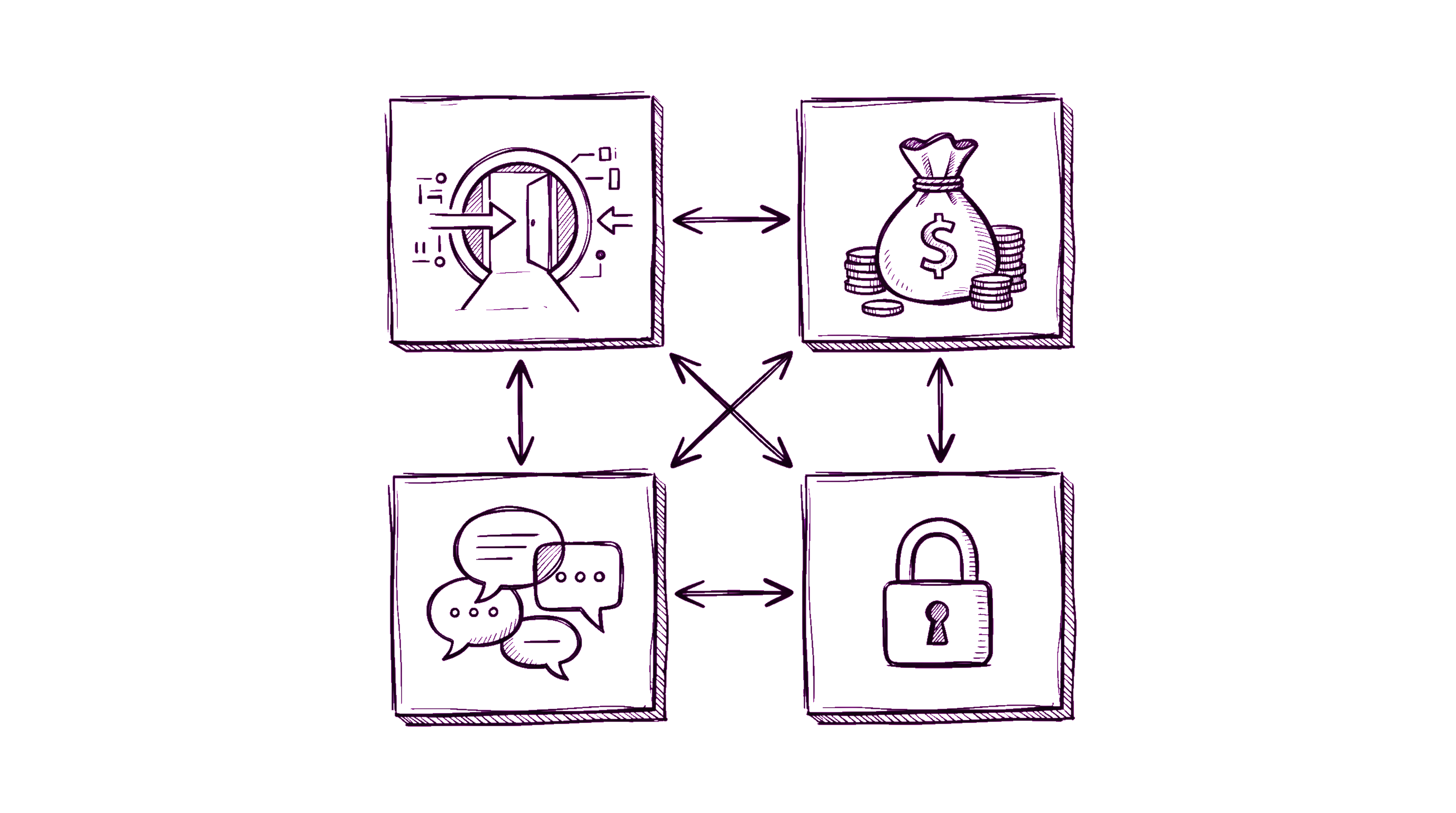
If you Google "best HR tech stack" you get back lists of 20+ tools. They're usually authored by review sites that earn affiliate commission per signup. The actual stack a 50-person company needs is four tools. Maybe five. Definitely not twenty.
This is the lean version, with the four things to buy now and the six things to skip until you're substantially larger.
The 4 tools you need at 50 people
1. Employee portal
For: directory, org chart, absences, basic 360 reviews, internal knowledge base, office floor plan if applicable.
Why it's first: it's the daily-touchpoint UI for every employee. Without it, the operational HR layer fragments across spreadsheets and Slack.
Examples: DTPulse, BambooHR, Lattice, Personio (EU), Hibob.
Cost: $5–$15 per employee per month. At 50 people: $250–$750/month.
What to look for: SAML SSO support, CSV import, configurable absence approval chains, public holidays per country, mobile-friendly. Beware of bundles that include payroll and ATS — those are usually weaker than dedicated tools in those categories.
2. Payroll
For: paying people legally and on time.
Why it's second: countries are different. The payroll vendor that works in the US doesn't work in Russia. The one that works in Russia doesn't work in Germany. There's no global option that's actually good.
Examples: country-specific. US — Gusto, Rippling, Justworks. UK — Deel for international, Xero Payroll for local. Russia — Контур.Зарплата, 1С:ЗУП. Germany — Personio Payroll, Datev. EU — Personio, Deel.
Cost: per-employee fee, $5–$15/month/employee at this scale. At 50: $250–$750.
What to look for: the payroll feature you need is just "calculate gross-to-net correctly and file the right taxes." Resist the upsell into "Total HR Suite" — payroll vendors that pretend to also be HR-portal vendors are usually weaker at both.
3. Communication (Slack / Teams / Google Chat)
For: the messaging layer.
Why it's third: you already use this. The HR-relevant fact is: choose ONE and let HR tooling integrate with it. Don't try to use Slack AND Teams AND email for HR notifications — your notifications will fragment and people will miss them.
Cost: $7–$15/user/month for Slack or Teams or paid Google Workspace.
What to look for from HR-integration perspective: SCIM provisioning, slash commands, message notifications from your portal (vacation approvals via DM, etc.).
4. Identity provider (Google Workspace usually counts)
For: SSO into everything; one-place offboarding.
Why it's fourth: at 50 people you probably already have Google Workspace or Microsoft 365 because of email/docs. That counts. Use its SAML/OIDC SSO into every SaaS tool you buy. Now offboarding is "disable account in Google" instead of "remember 18 tools to disable in."
Cost: usually $0 additional (already paying for the email side).
What to look for: SAML support, ideally SCIM for user provisioning. Most Google Workspace / Microsoft 365 plans include this; verify your tier.
What's NOT in the stack at 50 people
Applicant Tracking System (ATS)
For: tracking candidates through interview pipelines.
Why skip at 50: at 50 people you're hiring 5-10 people per year. A Notion database, a Trello board, or a Google Sheet does the job. ATS becomes useful at 100-150 people when hiring velocity passes ~25 hires/year.
When to add: when you hire 2+ recruiters or when your average open-pipeline count exceeds 50.
Examples for later: Greenhouse, Lever, Workable.
Performance management platform (separate from portal's 360)
For: deep performance management — calibration, comp linkage, succession planning, goal cascades.
Why skip at 50: your portal's built-in 360 review feature handles the level of formality you actually need. The dedicated performance-management platforms are designed for 500+ person companies with multiple HR business partners.
When to add: 250+ people when you have your second People hire.
Examples for later: Lattice, 15Five, Culture Amp.
Learning Management System (LMS)
For: tracking required training (compliance, security, etc.).
Why skip at 50: you don't have enough required training to justify the system. The training you DO have — security training, harassment training — can be done via the vendor's own portal (KnowBe4, etc.). Don't buy a wrapper-LMS.
When to add: when you have specific compliance obligations (regulated industry) or when training compliance becomes audited.
Compensation management software
For: building bands, modeling promotions, benchmarking.
Why skip at 50: a Google Sheet with bands and current employee salaries does the job. The benchmark data is the actual value — buy a benchmark subscription (Pave, Carta, Mercer) and keep the modeling in Sheets.
When to add: when you need to model compensation for 100+ people across multiple geographies with multiple equity stages — usually 200+ headcount.
Engagement-survey platform (separate from portal's eNPS)
For: deep engagement surveys with extensive question banks, benchmarking against industry, change-over-time tracking.
Why skip at 50: the portal's built-in eNPS / pulse-surveys feature handles monthly check-ins. The dedicated platforms (Culture Amp, Glint) start adding value when you want to benchmark against industry peers — usually 200+.
When to add: when you've been running eNPS monthly for 12+ months and want depth beyond what the portal offers.
Project management for HR initiatives (separate from your team's PM tool)
For: tracking HR projects (employee handbook rewrite, manager training rollout, etc.).
Why skip at 50: use whatever the rest of the company uses (Linear, Jira, Trello, ClickUp). One PM tool for the whole company is correct at this size. HR-specific PM tools (Trakstar, etc.) add no value at this scale.
The total bill
For a 50-person company:
| Category | Cost / mo | Cost / yr |
|---|---|---|
| Employee portal | $250–$750 | $3k–$9k |
| Payroll | $250–$750 | $3k–$9k |
| Slack / Teams (HR allocation, prorated) | already paid | — |
| Google Workspace / Microsoft 365 IdP | already paid | — |
| Total NEW HR-tooling cost | $500–$1,500 | $6k–$18k |
That's the budget. Adding more tools at this scale almost certainly produces less ROI per dollar than adding a person to the team.
What's worth spending MORE on
A few categories where penny-pinching backfires:
- Background-check vendor when you start hiring at any scale (Checkr, etc.). The cost of a bad hire dwarfs the per-check fee.
- Compensation benchmark data before you start leveling. The price of a wrong-band offer is 12-24 months of suboptimal retention.
- Legal counsel on first hard termination. Save on retainers for 12 months, lose 24 months of revenue on a wrongful-termination suit.
These aren't HR-tech-stack items per se but they're the line-items in the "people budget" that earn back their cost the most reliably.
How DTPulse fits
For full transparency: DTPulse is in the "Employee portal" row of the table above. We don't try to be your payroll, your ATS, or your LMS. We try to be the boring, daily-touchpoint operational layer that handles the obvious workflows so that the rest of your stack can specialize.
A 50-person company using DTPulse for portal + Gusto (or country equivalent) for payroll + Google Workspace for IdP/comms is a stack that costs ~$1k/month and works for the next 2-3 years of growth without re-platforming. That's the bar we're aiming at.