A Harris Poll released on May 29 landed badly across HR feeds: 60% of currently employed U.S. workers describe their current boss as toxic, 70% have experienced one in their career, and the average tenure under a toxic boss before leaving has dropped to under two years. Those are not the kind of numbers a once-a-year leadership training shrugs off. They are not, however, what most HR teams catch in time, because the toxic boss problem is structurally invisible to the systems most companies use to measure manager performance.
What the survey actually says
The headline is the 60%, but the interesting wrinkle in the Harris data is who gets blamed. Seventy-one percent of respondents said the cause is systemic pressure on managers, not individual character flaws. Pressure from above, ambiguous role expectations, no real management training, no time to actually manage. Sixty-four percent named coaching and leadership training as the single most effective remedy. Only 9% wanted the toxic boss fired outright.
That framing changes what HR should be optimising for. It is not "find the bad apples and remove them." It is "find managers under structural strain early, give them a real development path, and measure whether the strain is going down." The Harris number tells you the labor market has noticed. The remedy framing tells you employees themselves are pointing at the same fix HR has always claimed to provide and rarely does at the cadence that matters.
There is a second number worth pulling out. Among workers who said they had a toxic boss currently and were looking for a new job, the most common reason cited for not yet leaving was "no clear alternative." Translation: the toxic-boss tax is being paid by your retention budget before it shows up in any survey field. By the time the engagement score drops, the resume is already on the market.
Why standard HR misses the signal
The annual engagement survey is the most common tool aimed at this problem and the worst suited to it. Three reasons.
First, the lag. Between the month a manager started running their team into the ground and the month HR sees the dip in the annual report, six to nine months pass. By the time you read the report, your worst-affected team has already lost two people and is one bad week away from losing three more.
Second, manager dimension averaging. Most annual surveys report at the org level, sometimes at the function level, occasionally at the department. The manager dimension gets averaged out. A company with two great managers and one disaster comes out with a "B+" engagement score and no one knows where to look.
Third, anonymity that is not actually anonymous. When the annual survey asks "rate your direct manager 1 to 10" and your team has four people, the manager can guess who gave the 3. The team knows the manager can guess. The 3 stops appearing. The 7 starts appearing. The survey is now lying to you, politely.
Add to this that 360 reviews, where they exist, are often annual, often tied to compensation decisions, and often run with named reviewers. None of those conditions encourages honest manager feedback. They encourage compliance feedback. You get the boss your team thinks the boss wants to hear about, not the boss they actually work for.
Four signals an HR stack can actually catch
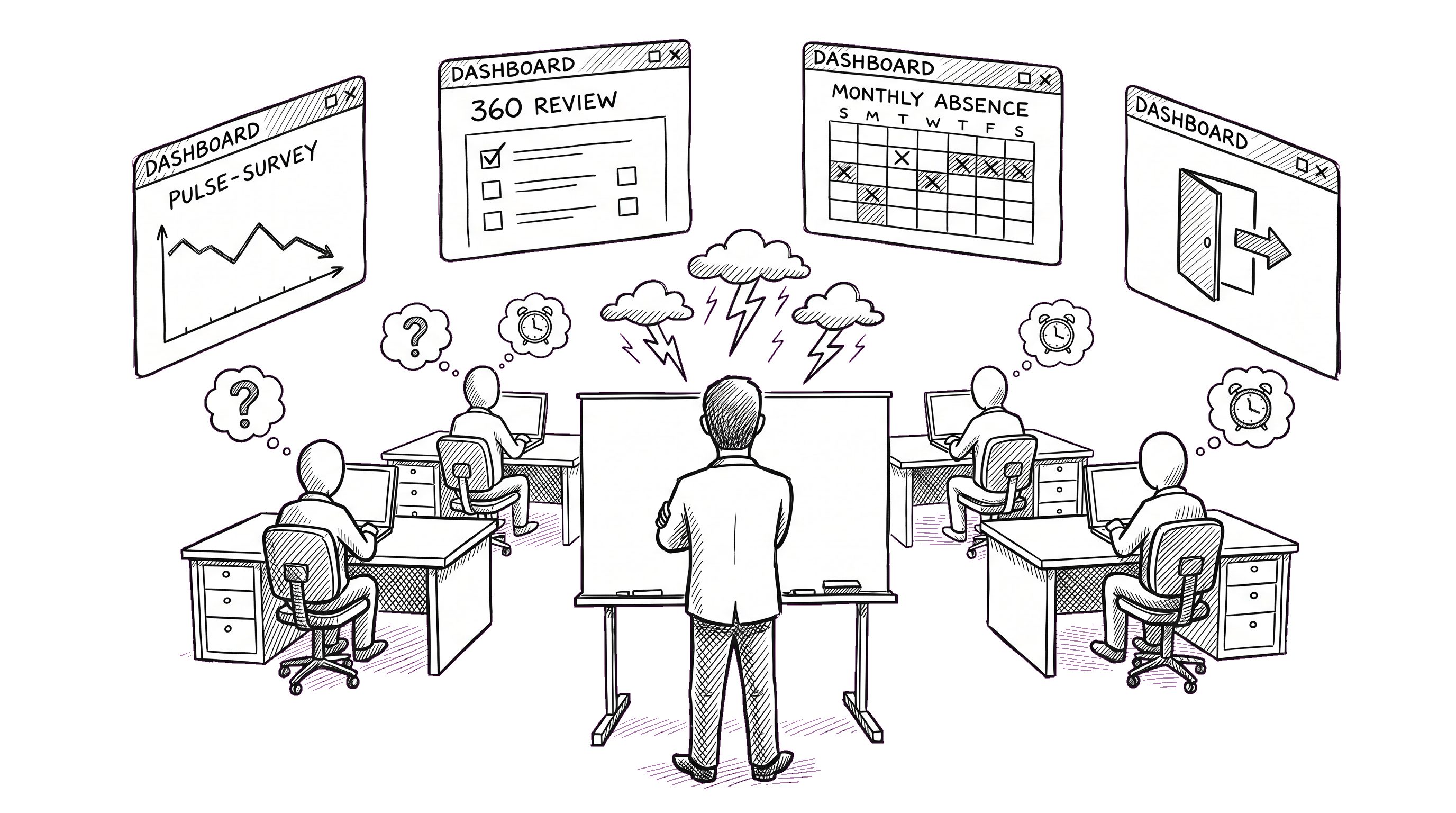
A working toxic-boss detection setup uses four signals together. None of them is reliable alone. Together they triangulate.
Pulse-survey trend by team, not absolute score. A pulse-survey result of 3.8 in one team and 4.2 in another tells you very little. A pulse-survey result that has dropped 0.4 in four consecutive cycles in one team while the rest of the company is flat tells you exactly where to look. The cadence matters more than the questions. Weekly is too noisy, monthly is too slow, every two weeks is the sweet spot for most teams.
Anonymous 360 feedback on managers, ideally quarterly. Not the annual ritual. A short 360, eight to twelve questions, anchored to specific manager competencies, run quarterly with team-level aggregation and a minimum threshold (five responses or no result shown). The questions are formative, not summative. "Does your manager give clear feedback when something is off?" not "Rate your manager 1 to 10."
Absence and PTO patterns. When one team's sick days climb 50% above the company average over two months, something is happening on that team. It might be flu season hitting one floor harder. It might be a manager whose 7am Sunday messages have made Monday morning physically difficult. The pattern alone is not a verdict, it is a question worth asking.
Voluntary attrition by manager, lagging twelve months. This is the rear-view-mirror signal, but it matters. If a manager has lost four people in twelve months and three of them cited "fit with leadership" in the exit survey, you have data you cannot dismiss. The trick is to track this manager-by-manager from day one, not to reconstruct it after the third resignation.
None of these signals justify a firing. All of them justify a conversation, a development plan, and a measurable check-in six months later.
What DTPulse does with this
DTPulse is built around the assumption that the HR stack should make the four signals above easy to see and hard to weaponise. Pulse surveys run on team-level aggregation by default. Below the threshold, results roll up to the parent department rather than expose individual responses. The view that loads first is not the absolute score, it is the delta across the last three cycles, because the delta is where the story is.
360 reviews are structured around competency matrices, so a manager's "what to work on" lands as "this specific competency needs development based on this team's feedback" rather than as a vague "your team thinks you're harsh." Reviewer identities are masked by default, with an opt-in for named feedback when the reviewer wants their input attributed. The same 360 can be run quarterly without the friction of the annual ritual, because the questions are short and the analysis is on the same screen as the data.
Absences live next to org-chart and team views, so the pattern (one team trending high on unplanned absences) is visible without anyone running a report. Attrition, planned and unplanned, sits next to the same team view.
The point is not surveillance. The point is formative. A manager who sees their own pulse trend, their own 360 score on a specific competency, and their own team's absence pattern should be the first person to bring it up with their HR partner, not the last person to find out about it.
If you want the longer argument for why 360 reviews work better when employees do not dread them, the playbook is in 360 reviews people don't dread.
The development loop, not the witch hunt
The single fastest way to destroy a manager feedback system is to use it as evidence. Pulse scores cited in performance reviews, 360 comments quoted in firing conversations, anonymous feedback subpoenaed for an HR investigation. Once that happens once and the team finds out, the feedback dies. The pulse becomes a flat 4, the 360 becomes a flat 7, and the next toxic manager passes the screen.
The working loop has five steps and does not include "fire the manager."
- Signal surfaces (pulse delta, 360 score, attrition spike).
- HR partner has a conversation with the manager, not a confrontation. The conversation is about the pattern, not about specific quotes.
- A development plan with two or three specific competencies and a coaching cadence.
- A measurable check-in at three and six months: did the pulse delta close, did the 360 score on the specific competency move, did the team's absence pattern normalise.
- If after twelve months the pattern persists and the development effort has been genuine, then a harder conversation about role fit happens. This is where the witch-hunt instinct gets a legitimate outlet, after the formative work has been tried.
The Harris Poll respondents who pointed at coaching and training as the remedy were not asking for soft treatment of bad managers. They were asking for a system that catches the strain before the manager becomes the problem.
Conclusion
The 60% number is not new in spirit, but the 71% number, the one that says employees blame the system more than the person, is the actionable insight from this survey. The HR stack that handles it is not exotic. Two-week pulse cycles on team-level aggregation. Quarterly anonymous 360 on competencies. Absence and attrition patterns visible by team. A development loop with named owners and measurable check-ins.
If you are running an annual engagement survey and an annual 360 and that is it, you are paying the toxic-boss tax in attrition without seeing the bill until the resignations land. The fix is not a bigger annual survey. The fix is a smaller, faster, more private one running on a cadence that matches how teams actually go off the rails.
Source: 6 in 10 workers say their boss is toxic, HRDive, May 29 2026. DTPulse plans that include pulse surveys and 360s, in the pricing section on the home page.